CHRISTIAN
ACHENBACH
and
ANSELM
REYLE
in
Conversation
with
Ida
Baier
Following
the
Chalk
Line
May 2026
"That secret is exactly what you’re chasing the whole time – it’s what lets you keep going. We’re always trying to make something better and to achieve more, even though that’s unattainable."
– Christian Achenbach
"That secret is exactly what you’re chasing the whole time – it’s what lets you keep going. We’re always trying to make something better and to achieve more, even though that’s unattainable."
– Christian Achenbach
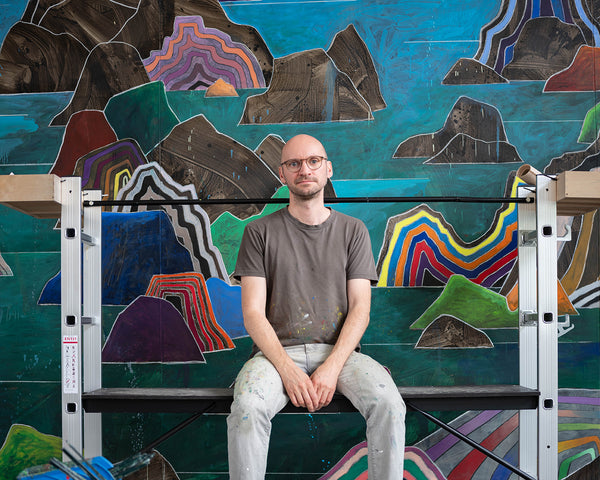
Christian Achenbach, Ida Baier (curator and founder of Berlin-based exhibition space Ida’s Room), and Anselm Reyle (artist and professor of painting at University of Fine Arts Hamburg) met at Achenbach’s studio in Berlin’s Weißensee district for a conversation on a Thursday evening in May 2026. Achenbach studied under Reyle when the latter was a guest professor at the University of the Arts Berlin in 2007.

© Photo KÖNIG GALERIE
Ida Baier: Christian, Anselm Reyle took over your class, previously led by Daniel Richter. In artistic terms, it was quite a break from his predecessor. How did that affect you?
Christian Achenbach: I had three different professors: Burkhard Held, Daniel Richter, and Anselm Reyle. One difference was that painting was no longer the central topic in Anselm’s class, but rather one of many artistic options. It was an experimental environment with a really pleasant, relaxed atmosphere from the beginning. You had the sense with Anselm that he became a professor because he truly enjoyed working with people. I was painting fairly large-format works back then, depicting quirky figures noodling on their instruments. That was my world then. Anselm thought that was good. In fact, I was already highly independent as a student, renting my own studio to have my freedom. Anselm was a reason to spend more time at the University of the Arts.
Anselm Reyle: When I took over the class, it consisted mostly of wannabe Richter acolytes only there to copy the master. I came as a shock. Perhaps something similar was happening back then with Markus Lüpertz, but I thought it had long since passed. Then there I was, the stripe painter. It was a shock for many. It wasn’t easy, is also why I only did it for one year. That was almost twenty years ago, so it’s nice to hear that you experienced it as a relaxed space. I had a migraine the day before and the day after. It was truly hard work. Most people were disturbed by the fact that someone else, making completely different art, was suddenly standing there. That wasn’t the reason why they were a part of the class – they didn’t want to paint stripes. Naturally, I didn’t want them to, either. What I found most important was having the class remain as heterogeneous as possible, without it immediately becoming evident that they were part of Reyle’s class. I thought it was good when not everyone was painting but perhaps doing sound or installation art. It was about developing an independent formal language – like Christian did.
CA: I spent a little time working for Anselm in his studio after completing my studies. It might be hard to believe now, but back then I was stand-ing beside Alicja Kwade, painting stripes for Anselm while listening to heavy-metal music by Slayer. I liked that. That must have been 2008. But I was first approached by a gallery just after completing my degree, which quickly led to my own exhibitions.
IB: For many years after you finished your studies, your works were wholly abstract. The first paintings to include figures were created around 2021. But I don’t really regard this turn as a rupture because the landscapes, such as the ones we’re looking at here, were the result of the same sensibility as the abstract paintings – the brushstroke had merely taken the form of landscapes. Does that mean that the landscape as a motif is more a means to an end for your painterly expression?
© Photo KÖNIG GALERIE
CA: As you rightly note, this change was a fluid transition. My abstract paintings tried to explore the tension between the expressive and the geometric. But then I needed to bring content back into the image. I was interested in the boundary between re cognisability and abstraction. I’m still using the same surface effects and painterly devices as in my purely abstract works. In doing so, I deliberately make use of landscape painting clichés. This could, for instance, be a trite staring- at-the-sun moment we’ve seen across centuries of paint-ing. My painting isn’t about landscapes I myself have experienced. I deliberately leave the exact location open. This lets me concentrate on what interests me the most: the landscape as a cultural image, and thus how perception itself is constructed. Here, the interplay of colours, the composition, and the visual rhythm are my parameters.
IB: But you limit yourself to landscapes, and figures have still not returned to your paintings.
CA: For now, I’d like to bracket out the narrative that figures in a painting inevitably bring. For me, a painting doesn’t need this straight storytelling. My own unique way of looking at the world will subtly influence the work in any case and can’t be concealed. I’m not one to convey my point of view and convictions directly through the content of my painting. Landscapes work so well for me because I can work through an external reality without telling a story.
© Photo KÖNIG GALERIE
IB: Ultimately, the compositions comprise geometric fields as well as organic elements…
CA: I always try to exhaust all contrasts available to me. The ‘classical’ contrasts are light/dark and warm/cold, but naturally other contrasts can include crashing together something highly graphic and controlled with something very organic and expressive. This creates a very special energy I like using in my paintings. On the one hand, there were movements including Abstract Expressionism and Art Informel in the 1960s and ’70s that celebrated the gestural, while on the other hand you had movements like Op Art and Hard Edge, which sought to banish the artist’s individual hand from the work. I find it exciting to see what happens when the two are brought in tandem. My paintings are spaces in which different eras and systems of painting come together without competing. They are, if you will, paintings that know they are paintings and make their peace with the history of painting.
IB: How has this focus changed your working processes and where does a new painting end for you?
CA: I’ve developed the habit of first applying a diffuse grey underpainting. In doing so, I often already create something worth following. You can almost find the painting in the primer. Then everything begins in earnest with a drawing, for which I use white chalk. There’s usually something of a roadmap or an idea for the painting, but it’s important not to simply execute this faithfully. Paintings always change over the course of the process. It’s not as if I know exactly where I’m headed – if I did, I’d be bored.
IB: So, the primer already shapes the form?
CA: Yes, and then everything follows the chalk lines.
AR: And you can still see this line when the painting has been finished.
CA: Exactly. I often leave that chalk line in place when I’ve finished because it offsets the heaviness of oils. Oil paints can feel very heavy and final. Chalk is more transient and gives the image a buoyancy which I find very important.
AR: For me, this lightness is one of the central elements connecting us. Originally, this was actually a conscious provocation in the face of brown, heavy, content-laden German oil painting, as well as a constructed conceptualism – and it worked, too.
CA: Absolutely. What we both also share is, of course, a soft spot for strong colours. When I’m abroad, people often tell me I’m a ‘very un-German German painter’. Some people can’t even believe I’m a German artist.
IB: But this feeling doesn’t derive solely from your use of colour.
AR: That’s true. There’s also a lightness – the chalk line as a stylistic device – and your effort to ensure that art never ends up looking like ‘work’.
CA: It should be like a good pop song, immediately catchy – it sticks in your ear right away, but at the same time it needs to have a depth that prevents it from growing stale too quickly. The ideal state would be a painting one can enter without effort, yet with so much depth and detail that you can linger there for a long time. I’m trying to make something that’s at once accessible and cryptic.
IB: In music, you can also have a certain pattern and rhythm over which an independent melody is laid.
AR: To me, these geometric elements speak to human creations. They’re essentially Op Art motifs borrowed from architecture and design that offer a contrast to nature.
© Photo Mika Gentili
CA: Exactly. Nature is everything that humans haven’t made.
AR: These things come together in a very exciting way in your works. The sun is designed and has stripes. They can’t be separated. Here, I have to think of Sonia and Robert Delaunay.
CA: For me, it’s not at all about whether something is a sun or a moon. A single circle in a picture will immediately become a dominant element that sites the entire image and forces the composition to click into place. Robert Delaunay is a good reference here – aural elements are very important in his idea of Orphism. But I also often find myself thinking of Kenneth Noland’s Circle Paintings and Jasper Johns’ Targets.
IB: Anselm, was your approach influenced by your students?
AR: Absolutely. I automatically encounter what students are finding interesting – what’s in the air. I also look at what they’re wearing and what music they’re listening to. Ideally, the interest is mutual. Ultimately, I benefit from that too. I’m someone who works heavily with what’s out there. I walk through the city and dis - cover what’s already there, whether stripes or silver foil. It’s an important source of inspiration.
IB: What does what’s out there look like to you, Christian?
CA: Naturally it’s the city, simply because I’m living in Berlin, but I’m always trying to spend more time in nature, in the mountains. I have a whole archive of photos of trees and of plants, and some-times I sit down to draw. Letting what’s out there flow into my work brings me great pleasure, even if I transform everything in my studio, recombining it all. But part of what’s out there these days are the images that can’t actually be viewed firsthand – land scapes from Google Earth, Instagram, computer games, or even images com pletely generated using AI. They shape our under-standing of the landscape just as much as art historical landscape paintings do. I work with all this material.
IB: Does your work process have a digital aspect?
CA: I often photograph the can-vases in my studio and look at them on the computer at home, and then I try out different decisions about the composition or colour. My digital archive of specific visual elements is an important tool. But it’s really important for it all to have its own power and presence when viewed in person and not just on a monitor or as a little tile on Instagram. It’s very much precisely about creating something that can’t be digitally reproduced.
IB: At a time when artists are increasingly expected to be visible and present in the media, do you think while working about how the public will receive your work?
CA: I once had a collector ask me if I conducted surveys on what people liked best. But on the contrary, I often shape my paintings primarily to please myself, so that I feel like heading to the studio each morn ing. You can only be really good at something you enjoy doing. I try to make the painting I would most like to see, even if it wasn’t my painting. What would hold my interest?
AR: I conduct surveys in my studio. I ask my assistants or the cleaners what they like best. I don’t think I’m fundamentally different from others, but people do know what’s good and what isn’t. This way of communicating is truly an integral part of my work.
IB: In that case, to what degree does painting then become conceptual art?
AR The conceptual element figures heavily in my work. In a painting using plastic film, for example, I transfer material used for shop windows onto canvas in order to create an abstract painting. Christian’s paintings probably emerge more from his process.
CA: I think that first and foremost, a painting has to work on its own terms. The painting itself has to be able to uphold the concept. When it’s only comprehensible thanks to the concept, then the work itself is superfluous. Often, a concept imposes a meaning a work of art can’t uphold – a meaning for which art may not even be the appropriate medium. It might be some-thing more suitable for social or political discourse – and thus should be articulated through language.
IB: What does a painting require to function autonomously?
CA: The right paint, in the right pro portions, in the right spot. That says a great deal and nothing at all. In the end, it’s a secret, and this secret makes it so fascinating over time. When you stand in a room and can’t pin down why it has the effect that it does.
IB: Is that feeling there from the start or is it something you have to learn?
CA: I think most artists are by nature very sensitive to what’s happening around them and take everything in before processing it in their own way. You can’t do more than take in what’s around you visually. Thus, you’re automatically a child of your time. You’re a sponge that soaks everything up, then lets it all out in the studio.
IB: So, the artist becomes a witness to his time.
AR: Well, I think studying is ultimately about spending a lot of time with a lot of people interested in similar things – in art. Maybe also in music and clubs and drinking. At one point, a feeling for art develops. Naturally the lecturing professor plays a role, but developing one’s own work is the most important thing, spending time thinking about art and talking with people of your generation about art and much else, to grow into that.
IB: This feel for how something works in a room brings us to your practice as sculptors. Christian, you chiefly work with glass and Anselm, you make ceramics. What led you to these choices?
C:A To be honest, I started working with glass more or less by chance after a fellowship took me to Switzerland. I was fascinated by how glass catches the light and glows from within. It changes over the course of the day with the angle of light. For me, working with glass is a way of painting in 3D.
AR: At times, I had a team of up to sixty people working in my studio. At some point, I was only working on an operational and technical level. It felt like a prison. Then I took a break and started working with ceramics – in part because you have to cede control. You never know exactly what’s going to happen in the kiln.
CA: For me, that moment when you somewhat relinquish control – when you don’t know how the piece will come out of the kiln – is a pivotal moment. Glass is also the exact opposite of oils. You can always keep changing a painting, but glass is so fragile you can’t get away with anything – a tiny crack and the object is ruined.
IB: This almost clinical precision with glass stands in stark contrast to the freedom nature offers, to which you’re increasingly drawn. Do you think land scapes are a story that will one day reach an end?
CA: Of course, nature has a never- ending diversity of forms. Whereas the history of art is about 2,000 years old, nature has had millions of years to develop. It opens up an infinite source of inspiration.
AR: Yet I also see you as cheerfully acceding to clichés. You’re using mountains, the sky, and trees with the colours turned up so high that you almost feel you’re having a mind-expanding experience. I’m also all for ‘beauty’, as I think you are. Ultimately, beauty is what brings people together.
CA: This particular aesthetic – which is often described as ‘psychedelic’ – has been around for much longer, with roots in Symbolism, Art Nouveau, and the Wiener Secession. Moreover, it’s important for the paintings to have a strong presence and power.
© Photo Mika Gentili
IB: This aesthetic and directness also seem to resonate powerfully beyond Germany – not least because it’s readily apprehensible across cultural borders.
CA: In recent years, I’ve had the privilege of exhibiting in a diverse range of countries and cultures, including India, Mexico, South Korea, and China, as well as in many places in Europe, and it’s a true delight to see that the paintings work everywhere, wholly independent of culture and education. It’s like a piece by Johann Sebastian Bach: you can play it anywhere in the world and it immediately speaks to people, whether or not they know who Bach is.
AR: For me, it’s always about breaking through the rigid academic barriers and creating a sense of im mediacy. This means enabling a direct experience purely through colours and materials, with no prior knowledge required.
CA: After all, colour conveys sen sations and speaks directly to people on a highly emotional level. In psychotherapy, people are often asked to assign colours to their feelings – there’s obviously a direct connection. A landscape is a similarly universal motif and I’ve yet to meet someone who doesn’t like landscapes in and of themselves. And within that, I can play with countless quotes and references. But I’m glad when the paintings work for people who’ve studied art and people who have no background in art whatsoever.
AR: When I was studying, abstract paint-ing was extremely hermetic. It was art people made for people who had studied the subject, for experts, and for collectors – you had to bring that educated perspective.
IB: The so-called experts also set an awful lot of rules and regulations on what one may and may not do.
CA: When I was studying, I was con stantly being told, ‘You’ve got to break that! You’ve got to break everything!’ But I thought to myself: Why, really? Doesn’t breaking things hurt? Who likes breaking things? I find this dogmatic insistence on destroying a functioning form or colour in order to make ‘serious’ art to be rather hollow.
AR: As well as this fear of decorative things. Why should something decorative automatically be de-void of content? I’ve always been motivated by a desire to question these rules on what one can and cannot do.
CA: Yet ultimately, there’s simply no recipe for a good work of art. You can try describing it in language, but you can’t get to the heart of what it does to you. And that’s exactly how it should be. If it could be wholly deciphered using words, one wouldn’t need the work itself.
AR: A certain mystery remains, and that’s probably why I’m still making abstract paintings – because I myself don’t wholly understand them.
CA: That secret is exactly what you’re chasing the whole time – it’s what lets you keep going. We’re always trying to make something better and to achieve more, even though that’s unattainable.