© Images Roman März
TUE GREENFORT
WUNDERKAMMER
KÖNIG GALERIE | CHAPEL
ALEXANDRINENSTRASSE 118–121, 10969 BERLIN
5 JUNE – 12 JULY 2026
OPENING
4 JUNE 2026 | 6 – 8 PM
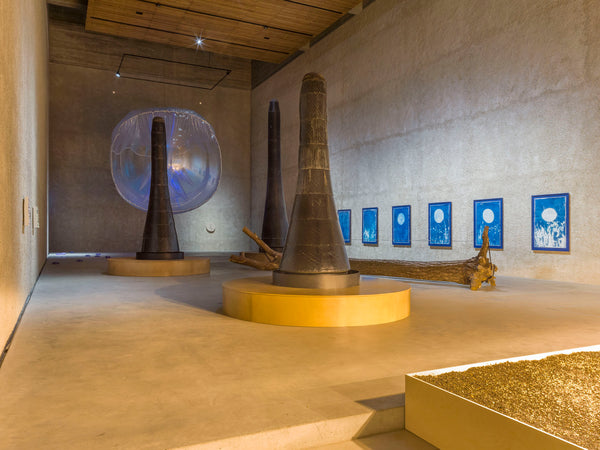
KÖNIG GALERIE presents WUNDERKAMMER, an exhibition of new and existing works by Danish artist Tue Greenfort in the Chapel of St. Agnes. It is the artist’s ninth solo exhibition at the gallery.
Tue Greenfort’s work explores the ways in which nature and the environment are perceived, categorized, and hierarchized by humans. Rather than merely deconstructing the anthropocentric view of nature, which often romanticizes it, he seeks to expand perspectives on flora, fauna, and ecology together with the viewers, raising new questions and awakening curiosity. At the same time, his work addresses possible new forms of coexistence between humans and nature.
The exhibition examines in the form of a "Wunderkammer" how Greenfort engages with these questions across different media and artistic forms, approaching a wide range of themes through artistic practice.
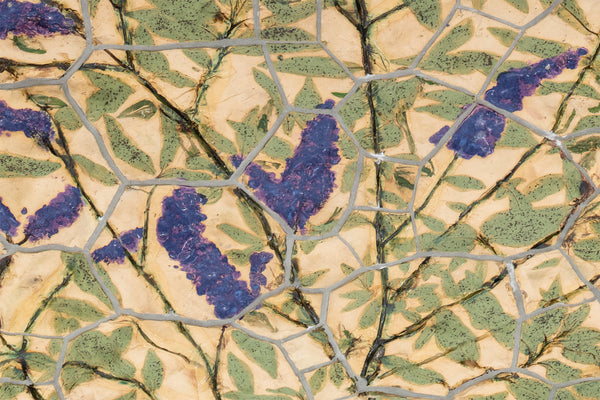
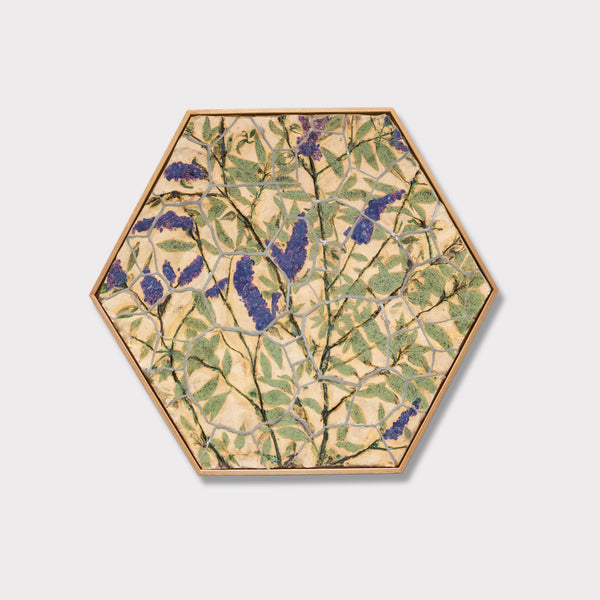
The hexagonal ceramic work BUTTERFLYBUSH BUDDLEJA DAVIDII II, for example, originates from a project Greenfort realized in 2021 for Rochester Square in London. He worked with invasive plant species and explored questions concerning the relationship between identity and place of origin—an issue made especially tangible in the capital of what was once a vast global empire.
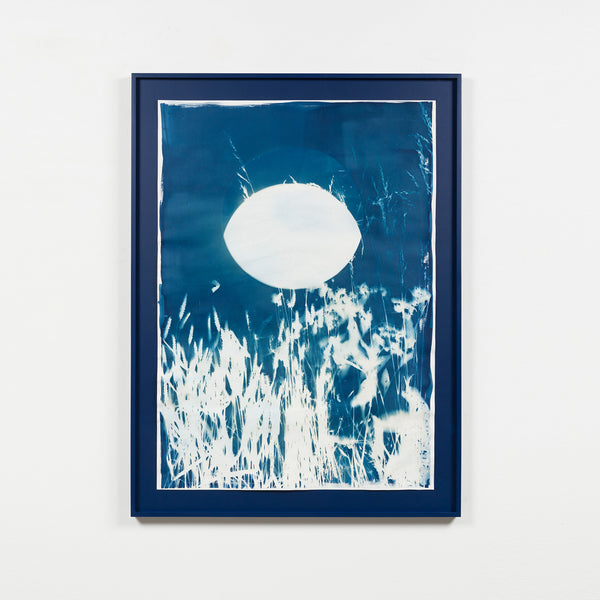
Greenfort approaches his fields of inquiry in an entirely artistic manner, incorporating both artisanal and artistic traditions. The cyanotypes on display, produced in Seoul, employ a nearly 200-year-old technique related to photography. They pay homage to the English botanist Anna Atkins, who popularized the technique through her documentation of algae and ferns.
Algae are the subject of works such as the two suspended glass sculptures ULVA II and III. They are organisms that resist clear systematization and classification while possessing a wide range of characteristics. Among the oldest forms of life on Earth, algae have continuously adapted to highly diverse living conditions over millions of years. Greenfort explored this thematic complex, among other contexts, in an exhibition presented in 2022 at the Eres Stiftung in Munich which was subsequently shown in parallel with the Biennale di Venezia in Venice, where the lagoon constitutes a unique ecosystem and where the exhibited water-filter works were created.
Also the work SACCA SAN MATTIA (2022) was created in Venice. Sacca San Mattia is one of the seven islands on which Murano, world famous for its glass production since the middle ages, is located. Their territory is urbanized, excluding Sacca San Mattia, which still is in the process of remediation. Sacca San Mattia is of artifical origin, made up largely of waste from the glass manufacturies.
The other beach sculptures were created in Tue Greenfort’s home Denmark.
In the vitrine, three purple glass objects are displayed that freely interpret the moon jellyfish. This jellyfish is the best-known and most common species found in the North and Baltic Seas. In his choice of medium, Greenfort references another traditional technique: the naturalistic glass models of zoological and botanical subjects produced in Dresden by Leopold Blaschka (1822–1895) and his son Rudolf Blaschka (1857–1939) for, for example, the collection of Harvard Museum of Natural History.
The glass artwork KELP STUDIES (2021), also in the vitrine, focuses on the group of giant kelps. The glossy brown glass evokes the surface of edible sugar kelp, a species of brown algae whose population is more and more declining.
Along one of the side walls of the Chapel hangs a series of drypoint prints entitled POACEAE (2022). Greenfort expanded the traditional printmaking technique — in which the motif is incised into a plate—by incorporating the motif itself, an ear of grain, directly into the printing process. Poaceae is the scientific term for a family of plants that includes many of the crops most essential to feeding the world’s population.
A work from the series FUNGI DECOMPOSITION was first shown as part of the group show Plastic World at Schirn Kunsthalle in Frankfurt. In it, Greenfort reflects on the wondrous organism of fungi and their widely discussed potential to break down plastic waste.
EXHIBITED WORKS


Tue Greenfort
Kelp Studies


Tue Greenfort
Ulva III


Tue Greenfort
EARTHSCAPE (COAST VI)


Tue Greenfort
EARTHSCAPE (COAST III)


Tue Greenfort
Sacca San Mattia, I

Tue Greenfort
Butterfly bush Buddleja davidii II


Tue Greenfort
Untitled (Beach Cast I)


Tue Greenfort
INVASIVE VIII


Tue Greenfort
INVASIVE II


Tue Greenfort
INVASIVE VII


Tue Greenfort
INVASIVE X


Tue Greenfort
Untitled


Tue Greenfort
Untitled


Tue Greenfort
Weed


Tue Greenfort
Weed


Tue Greenfort
Weed


Tue Greenfort
Weed


Tue Greenfort
Weed


Tue Greenfort
Poaceae V


Tue Greenfort
Poaceae IV


Tue Greenfort